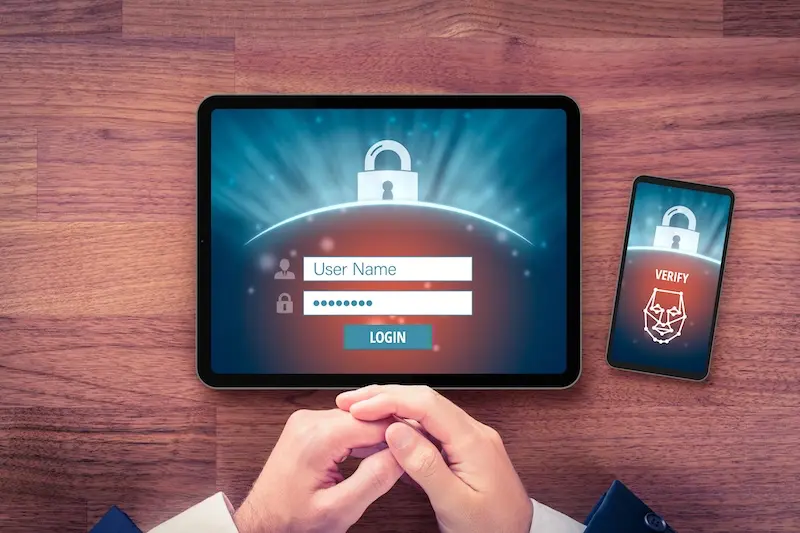
With cybercrime on the rise, businesses all around the world are turning to multi-factor authentication (MFA) as a way to immediately improve their security prowess.
This highly effective tool has become instrumental in preventing a significant percentage of targeted cyberattacks that attempt to compromise sensitive business accounts. In an era where cyber threats lurk around every corner, MFA should be mandatory across businesses of all sizes and within every sector.
Read on to discover why enforcing multi-factor authentication across all systems and users is critical to reducing risk and preventing unauthorised access.
What is multi-factor authentication?
As cyber threats continue to evolve, passwords alone can no longer be trusted to offer optimum protection against cyberattacks. This is where multi-factor authentication comes in.
MFA adds a vital extra layer of security by requiring users to verify their identity using two or more methods. This could include a one-time code sent to a mobile device, biometric verification such as a fingerprint, or a physical security token.
By combining multiple forms of authentication, MFA makes it far more difficult for attackers to gain unauthorised access to confidential data.
Why MFA is vital in 2026
With the NIS2 Directive expected to be transposed into Irish law this year, businesses all around the country must now prioritise their compliance efforts or face significant financial consequences.
Add to this the increasing prevalence of malicious attacks on both small businesses and large corporations, such as the recent act of cyber warfare on a Cork-based global company, and cybersecurity can no longer be an afterthought.
Placing a keen focus on creating a customised cybersecurity framework is the only way to provide your business with the thorough protection it needs in the current climate, and multi-factor authentication should play a pivotal role within this framework.
It’s a simple yet powerful feature that reduces the risk of unauthorised access at a time when passwords alone are no longer sufficient to safeguard sensitive data, and its function should not be underestimated.
How does multi-factor authentication protect your business?
MFA safeguards digital entry points to your business, ensuring your data is shielded by an extra protective force at all times. Based on this function, there are several key reasons why it is vital for your business:
Multi-factor authentication is a versatile security feature
According to a report by the Irish National Cyber Security Centre (NCSC), multi-factor authentication is a vastly superior solution to simply using passwords alone.
While phishing-resistant MFA is seen as the “gold standard”, app or voice-based authentication, as well as mobile push notifications, can also be used by organisations to verify their employees, suppliers, or customers.
It adds an additional layer of protection
Choosing to utilise MFA alongside other security features adds a robust layer to your existing protective framework.
When implemented alongside its fellow Microsoft 365 for Business tools, such as Conditional Access Policies, Advanced Threat Protection (ATP), and Mobile Device Management (MDM), multi-factor authentication further enhances the security of your systems and data.
It reduces the risk of specific attacks
From man-in-the-middle (MITM) attacks and phishing to brute-force attacks, there is a long list of common cyber threats that are mitigated by MFA.
Thanks to its layered approach to user access, MFA renders it almost impossible to infiltrate a protected system with a stolen password alone.
It can be combined with other cybersecurity tools for robust defence
When used in isolation, MFA is a powerful cybersecurity tool. However, when combined with other basic security practices, such as the use of anti-malware and carrying out regular software updates, it offers protection against 98% of all attacks.
Making the most of MFA implementation
Multi-factor authentication serves as an effective means to enhance your overall cybersecurity framework. However, its function can be optimised by adopting the following tactics in tandem with MFA implementation:
Utilise email security solutions that protect your team and business against email-borne threats such as malware and phishing.
Control and monitor access to cloud applications through secure cloud services.
Engage in Data Loss Prevention (DLP) by preventing unauthorised sharing of sensitive data.
Apply advanced firewall solutions to mitigate the risk of sophisticated attacks.
Implement Unified Endpoint Management and Endpoint Detection and Response to enhance threat detection and ensure security and compliance across all company devices and endpoints.
Creating an overall cybersecurity strategy that prioritises MFA along with other vital protective measures will help you to mitigate risk at every turn.
Enhance your cybersecurity strategy with help from the experts
Protecting your business from a myriad of cyber threats can be a daunting task when you go it alone. Partnering with an expert managed IT services provider will not only help you to stay on the right track but will also offer unparalleled peace of mind.
At Arbelos, we help Irish businesses unlock their full security potential by designing and implementing robust protections through our IT security and compliance services.
Whether it’s enabling multi-factor authentication or configuring advanced Conditional Access Policies, we focus on creating a secure, compliant environment that supports your day-to-day operations without adding unnecessary complexity.
As a trusted IT partner, our goal is to keep your business protected in an increasingly digital world, so you can concentrate on growth and success.
If you’re interested in discovering how multi-factor authentication can elevate your security strategy, get in touch with our team today. We will help you to harness the power of MFA and ensure your business’s security is stronger than it’s ever been.
If you’re looking to elevate your existing cybersecurity framework, it’s time to delve into the benefits of device compliance policies. These security assessment tools are essential for organisations around Ireland who strive to further safeguard their data, employees...
Conditional Access policies for SMEs have become instrumental in enabling business owners to reduce their level of cyber risk by adding a vital extra layer of protection to their existing security frameworks. If you’re new to the world of Conditional Access and would...
Understanding why and how to enforce MFA consistently and effectively across your entire organisation should be top of the to-do list for security-conscious business owners. MFA, which stands for multi-factor authentication, has been drastically improving the security...